
For an inmate in a California jail, the services of a remote online notarization are not available, at least until such a service becomes authorized by the correctional facility where the individual is detained. A notary who is willing to perform such services for an inmate should therefore consider visiting the jail, if permitted by the institution’s rules.
If you are seeking to get a document notarized for a family member, friend or client who is in custody, you probably ask yourself why you can't just use a webcam and a remote notary. The answer is simple—the laws of the land. Specifically California's laws, which currently prevent people from video conferencing to notarize documents due to identity, personal appearance, and general correctional security.
The particularities of arranging for a jail notary in LA county include the differences between standard RON procedures and the options available to inmates, as well as the entry and identification requirements specific to the local jails.
In this article you will be able to understand all of the details about the California notary laws, discover why a jailed person requires an in-prison notary service, and learn how a prisoner can schedule an on-site visit from a notary.
Can an Inmate Use Remote Online Notarization in California?
No, due to California's current notarization laws, the signer would be unable to appear via video chat, since California currently has a policy that for most notarial acts, the signer must be present, in the same room, with the notary, in person, and an incarcerated signer cannot do a California notarization over the phone.
It is easy to find contradictory information from various web sources that California has recently adopted the Online Notarization Act (SB696). Indeed, passing a law and its practical implementation are two different things. So, according to the California Secretary of State, notaries public in California can only perform notarial acts when the signatory is present in person. A video image or a webcam view of the signer is not considered sufficient “personal appearance” under California notarial law.
The state is currently putting the technological and regulatory infrastructure in place for RON in the future. Until the Secretary of State actually installs and certifies the operative system, California notaries may not perform this kind of remote online notarization.
It is also important to make a distinction between e-notarization and RON:
Electronic Notarization Essay: The electronic notarization process is performed in the presence of the signer and the notary. However, unlike the traditional method, the documents are executed and/or notarized on an electronic device, such as a computer or a tablet.
Remote Online Notarization: As for the remote online notarization, it involves notarizing individuals at different physical locations via closed audiovisual platforms.
Because California Notaries are required to be present in person in order to perform their duties, the current law is the main reason why regular RON is not an option for inmates. Even if the facility was willing to provide internet and webcams, which they are not likely to do due to security concerns, a California notary still would not be able to complete the RON legally.
Why a Jail Notary Visit Is Different From a Regular Mobile Notary Appointment
Hiring a mobile notary to come to a home or business in Beverly Hills or Santa Monica is a snap. But when it comes to jail or prison, your notary needs to know the ropes in order to get the job done safely and on time.
Los Angeles County Sheriff’s Department (LASD): Custody Manual Policy and Inmate Rights Issues Essay The Los Angeles County Sheriff’s Department (LASD) is the largest jail system in America. As stated in the LASD’s custody manual, a new regulation allows inmates to request notaries to come to their location and swear to any documents. However, it should be noted that the notary should be called upon in accordance with the specific instructions of the unit.
This means that a jail document notarization is heavily dictated by the environment. Key differences include:
1. Facility Clearance and Security Procedures
A mobile notary cannot just stroll into the Los Angeles County jail and ask to see the inmate. The notary has to go through security and is limited to what they can bring in with them. The notary also has to follow rules about what they can and cannot do in the jail. They can get in trouble for bringing in cell phones, briefcases, or certain pens or binders. This means the notary has to know what they can bring into the jail to fill out the notarial journal and certificate.
2. Variable Facility Rules
Do not think that the rules are the same in the Men's Central Jail as they are in the Century Regional Detention Facility (CRDF) or the Twin Towers Correctional Facility. It can vary depending on what jail you are in, what section you are housed in, and what is happening that day (such as a random lockdown).
3. Scheduling and Wait Times
Jail notarizations require much more time than a typical mobile notary appointment. A jail mobile notary will have to wait for an inmate to be transported to a designated visiting area within the jail. The notary must also be prepared to deal with custody staff in a professional manner.
4. Assessing Willingness and Competence
A notary’s primary duty is to prevent any kind of fraud or misrepresentation. Therefore, it is critical that the notary ensure that the signee is signing the document willingly and knowingly. In a correctional institution, the notary has to operate under the added pressure of a jail visiting room.
Jail Notary vs. Remote Online Notary: Key Differences
To clarify why an in-person jail notary service is your only practical option in California, here is a breakdown of the key differences:
| Factor | Jail Notary (In-Person) | Remote Online Notary (RON) |
|---|---|---|
| Signer physically present before notary | Yes | No |
| Currently authorized for CA notaries | Yes | No (System pending implementation) |
| Requires travel to the facility | Yes | No |
| Subject to facility security & approval | Yes | N/A (Webcam access would be required) |
| Identity verification method | Physical ID or Credible Witnesses | Digital identity proofing (where legally active) |
| Requires high-speed internet/video | No | Yes |
| Best suited for CA incarcerated signers | Yes | Not currently available or practical |
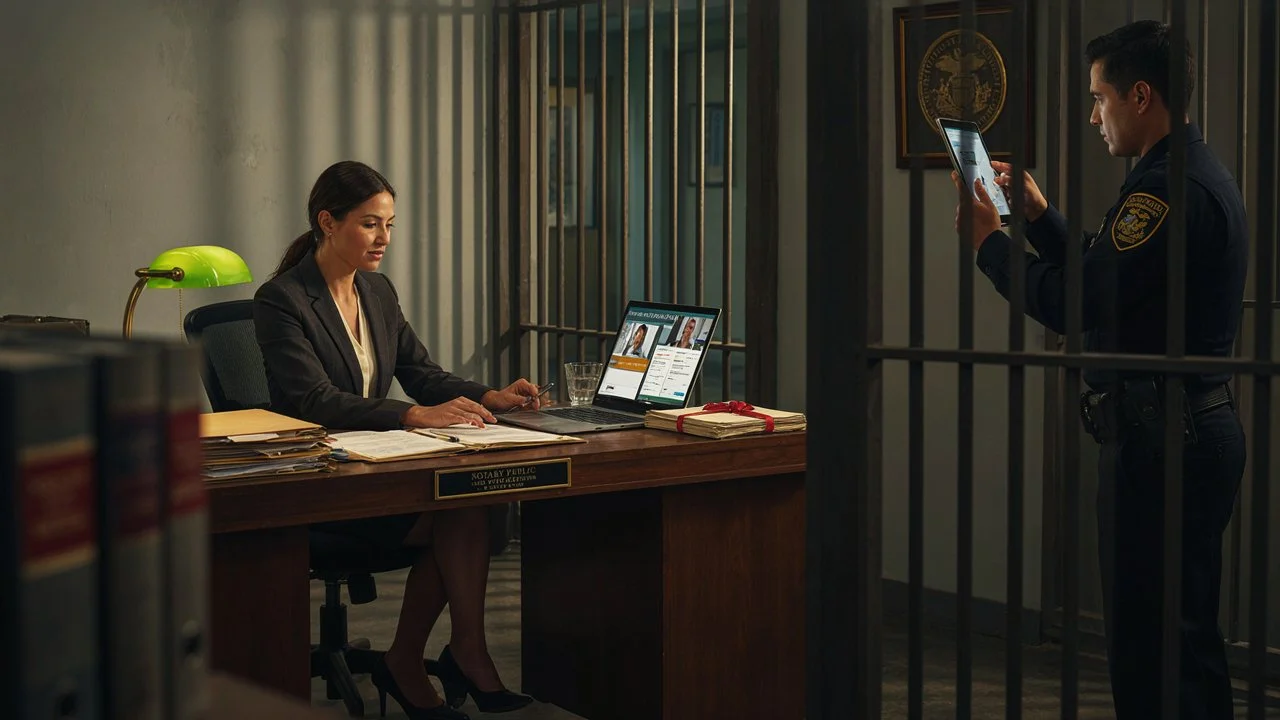
What Documents Can an Inmate Have Notarized?
Inmates often have to deal with outside affairs like legal, financial, or family issues while incarcerated. A notary public for jail documents can perform the same notarial acts inside the jail as they would outside like an Acknowledgment or Jurat.Common documents requiring inmate document notarization include:
Powers of Attorney (POA): This is probably the most common document we see here. An inmate wishes to grant a close relative or even an attorney the authority to act on behalf of them in relation to bank accounts, rent payments, or business matters.
Affidavits/Declarations: Are sworn statements and testimony of facts, written down and signed by the witness under oath or affirmation for the court.
Documents Concerning Estates: Wills, trusts, and advance directives often require notarization. A lawyer can help you with that.
Vehicle Release Forms: Sometimes, while being arrested, a person’s vehicle may be impounded. In such cases, they will need to notarize a vehicle release form, giving the right to a family member to take possession of it.
Family Law Documents: Child support, custody agreements, divorce papers, or any documents concerning the well-being and future of the child.
Important Note: The duties of a notary are limited to taking a true account of the identification process of the signor(s), confirming that all parties are signing voluntarily and accurately recording the notarial act. The notary is prohibited from preparing documents for signature or giving any legal advice regarding the content of the document. If you need assistance in preparing legal documents, you must contact an attorney before scheduling your mobile notary in Los Angeles County service.
What Identification Does an Inmate Need for a Jail Notarization?
Identity verification is the most problematic aspect of the correctional facility notarization. Once arrested, a person’s personal items, including a driver’s license, passport, or any other state-issued ID, are collected and held in the facility’s belongings.According to California law, a notary is required to make a determination of identity based on his/her "satisfactory evidence." A jail booking number or a paper wristband is not satisfactory evidence for a California Notary.So how does an inmate prove his/her identity if the wallet is on property?
1. Valid Government-Issued ID
If the inmate’s physical identification card is available (e.g., California driver's license, passport, etc.), this is the simplest option. If possible, have a family member bring his/her identification card to the jail for you when you come to notarize or have the facility bring the notary to view the ID in his/her possession (not all facilities may permit this).
2. Inmate Identification Card
The California Civil Code Section 1185 allows a notary to rely on the identification card issued by the California Department of Corrections and Rehabilitation (for inmates in a state prison) or an identification card issued by the local sheriff’s office (for inmates in a local detention facility). However, keep in mind that many county jails do not provide formal cards to temporary pretrial inmates, so it may depend on the particular facility.
3. Credible Identifying Witnesses
If no acceptable form of photo identification is available, the California law permits the use of credible witnesses. There are two options here:One reliable witness who knows the inmate and the notary public, ORTwo reliable witnesses who know the inmate, are not interested in the document being signed, and have valid identification. Witnesses should swear an oath or affirmation that they know the identity of the signer.Before scheduling a Los Angeles jail notary, you must clearly communicate the ID situation to the Notary so that they can take legal and practical measures.
Does a Jail Notary Need a Witness?
This is a common misconception regarding the notary jail signings. You must distinguish between various types of "witnesses" needed for the legal proceedings (in cases where the inmate cannot provide the notary with his or her personal identification)
Credible identifying witnesses: These are witnesses used solely for the purpose of establishing the identity of the inmate to the notary.
Document Witnesses: Certain legal documents (e.g., certain estate planning documents or other out-of-state documents) require one or more witnesses in addition to a notary.
Facility Witnesses: Certain facilities may have restrictions about who may be present during a legal visit.
Do not assume that every jail notarization requires a witness. If your document specifically requires witness signatures to be legally binding, you must make arrangements for this in advance. A notary can't serve both as notary and witness to the signature of the document, and jail personnel are unlikely to agree to witness any document.
How to Arrange a Jail Notary in Los Angeles
Coordinating a jail notarization service is not an easy task. Here is what you should know if you need to schedule an appointment in Los Angeles county:
Step 1: Identify the Facility
Get to know where exactly the person you want to sign the papers is being kept. You will also need to have the booking number, the full name of the inmate, and his/her location. In addition, learn that sometimes inmates can be moved around or transferred to court.
Step 2: Confirm the Document
Know what document needs to be notarized. Has the document been completed (other than the signature)? Does the document require an Acknowledgment or a Jurat? If you are unsure, contact the agency that will receive the document or an attorney.
Step 3: Confirm Identification Status
Determine what forms of identification are available. Does the inmate have their state-issued ID in their possession? Does a family member have physical identification? Are there any witnesses who can be called upon? Call your preferred mobile notary as soon as possible.
Step 4: Coordinate the Visit
Contact a professional who can do jail notarizations in Los Angeles. The notary should be made aware of any specific visiting hours, scheduling requirements, and professional visiting guidelines. Since the requirements can change at any time, a phone call to the jail to confirm the details might be necessary.
Step 5: Complete the Notarization
The notary will come to your facility, be cleared by security, and then meet with the inmate, who will have to be present in person, correctly identified and execute the appropriate notarial act in the next available sequential number in the notary's official journal and provide a thumbprint if the document to be notarized is a power of attorney or deed.
Step 6: Handle the Completed Document
Once the notarization has been completed, the document should be processed based on the individual's specific requests. In most cases, the notary can return the document to the family member who brought the individual in for the visit. In some cases, the notary may also be able to mail the document back to the family if the visiting relative has requested it and it is permitted by the facility.
What to Have Ready Before Calling a Notary
To ensure a smooth process and avoid wasted travel fees, have the following information prepared before contacting a notary public:The exact name of the correction facility and address.The inmate’s full name and date of birth.The inmate’s booking number.The document that is needed for notarization.The type of notary act needed if known (Acknowledgement vs. Jurat).Whether the inmate’s identification is secure.Any witness requirements for the document, if any.Contact information for your attorney or family member.Your deadline for the document completion.Remember that while you can prepare the groundwork, the facility has the final say on access, and they may impose additional requirements or unexpected delays.
Need a Jail Notary in Los Angeles?
Navigating through the intricacies of the notary law in California as well as understanding the local law enforcement nuances is often challenging, particularly when someone is already dealing with a stressful situation.At 24HourNotaryLA, we specialize in providing mobile notary services to clients across the Los Angeles area. From Beverly Hills and Downtown LA to other local locations, we offer our expertise in navigating the complexities of correctional facilities. We understand the intricacies of the process and can assist you with jail notarization appointments, considering the guidelines and availability within the facility.Whether you need an urgent power of attorney, an affidavit, or documents related to wills and trusts notarized, we can work with you to make sure everything is in order.
Disclaimer: The information provided in this article is for educational purposes only and should not be taken as legal advice. Jail procedures, requirements to identify, and document requirements can vary by facility and case. For legal questions about a specific document or the rights of an incarcerated person, it is best to contact a qualified attorney or the specific jail or prison directly.
FAQs
Can an inmate get something notarized in Los Angeles?
Yes. An inmate in a Los Angeles County jail can have papers notarized. A Mobile Notary is required to go to the facility where the inmate is housed to perform the notarization. This is subject to the entry requirements of that particular jail, as well as any restrictions they may have on who the inmate can meet with and whether they accept legal identification.
Can an inmate use remote online notarization in California?
No, not through a California notary, given the state's current laws. California law requires personal appearance for most notarial acts, so you can't get a California notarization via webcam. The jailed signer would need to actually come to the notary in person.
What ID does an inmate need for notarization?
A California notary public can take the identity of the signor using “satisfactory evidence.” In most cases, it refers to a valid official photo ID, like a driver’s license or passport. If a signor does not have an official photo ID, the notary can take the word of two credible witnesses who have a valid official photo ID.
Can a family member arrange a jail notary visit?
Yes. They are usually friends, relatives, or lawyers who do it on the inmate’s behalf. It is the responsibility of the friend, relative, or lawyer to set up the notary service for the jail. They have to make sure that the document is ready, the facility is correctly specified, and IDs are produced.
Does a jail notary need a witness?
Not necessarily. Witnesses are only required if the person lacks physical identification (such as a driver's license) and therefore requires "credible identifying witnesses" under California law or if the document specifically requires witnesses to sign it. It is not standard practice for a notary to require someone to bring a witness when they are signing as a notary.
How do I arrange a jail notarization in Los Angeles County?
To schedule a notarization, you need to know the inmate’s location (housing unit) and booking number, identify which document should be signed, and decide how the inmate will be identified. Next, you must contact a jail mobile notary that can gain access to your local jail’s specific professional visiting rules.
Can a mobile notary enter a Los Angeles County jail?
Yes, but they are subject to security checks. The Los Angeles County Sheriff’s Department allows notaries to come in for legal documents, but the notary has to follow specific security procedures based on each unit’s orders. They also have to be cleared of all prohibited items.